
By Bridget Butler, Harrison Trosper, Matt Zoglman, and Presley Potter | JUL 1, 2026
In a world of ever-developing technology, artificial intelligence (AI) has become one of the fastest growing technology markets on the planet. Despite ethical, environmental, and security issues, industries around the world have begun to implement AI into daily practices. Journalism is not an exception, with 43% of news publications believing they will need to hire employees with AI skills, stated in a survey by the London School of Economics.
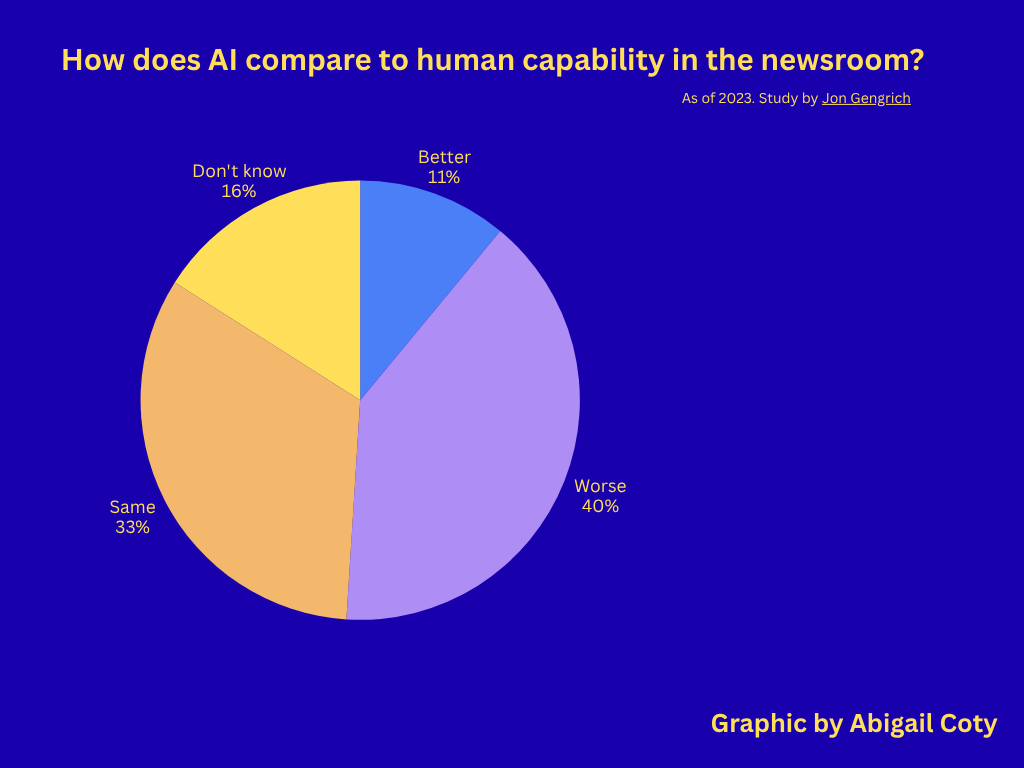
In a study conducted by researchers at the University of Minnesota’s Hubbard School of Journalism & Mass Communication and the University of Oxford’s Oxford Internet Institute, 40% of respondents believed AI technologies do a worse job than humans at producing news content, while only 33% felt they perform about the same (Valenzuela et al.)
In journalistic spaces, many use artificial intelligence as a research aid. Its primary function is to sift through vast amounts of sources and journals to lessen the monotonous workload that a journalist may experience during the research process. In a 2026 Berkeley study, researchers found that across fifteen different AI models, the average hallucination (creation of plausible information or outright falsehoods) rate was more than 21%. This demonstrates that while AI may be efficient at sorting and processing data, it is much more likely to miss crucial information than human researchers..
AI has also been used to create specialized news feeds for viewers with the use of algorithms. These filter behavior data, sending the most engaging content to raise the amount of time spent on news websites. While this may effectively show relevant articles to readers, this traps readers in information bubbles, meaning that they constantly only hear information that reaffirms their previous beliefs, rather than varied views . This can be dangerous, particularly when it comes to politically-charged content.
One area AI is often used in is automating repetitive tasks. Journalists have various tasks they have to perform over and over, which take valuable time away from writing their articles. Some of these tasks include proofreading and writing headlines. However, researchers have found that there is a large gap between the readability of human written text and AI written text. Because of the increased difficulty of reading AI written text, readers do not get as much use from it.
As time progresses and media literacy increases, the gap between trust and distrust in AI will only grow. It is important to acknowledge that AI has the capacity to be a tool, but also a hindrance if used incorrectly.