Photograph by Rocco Lucas
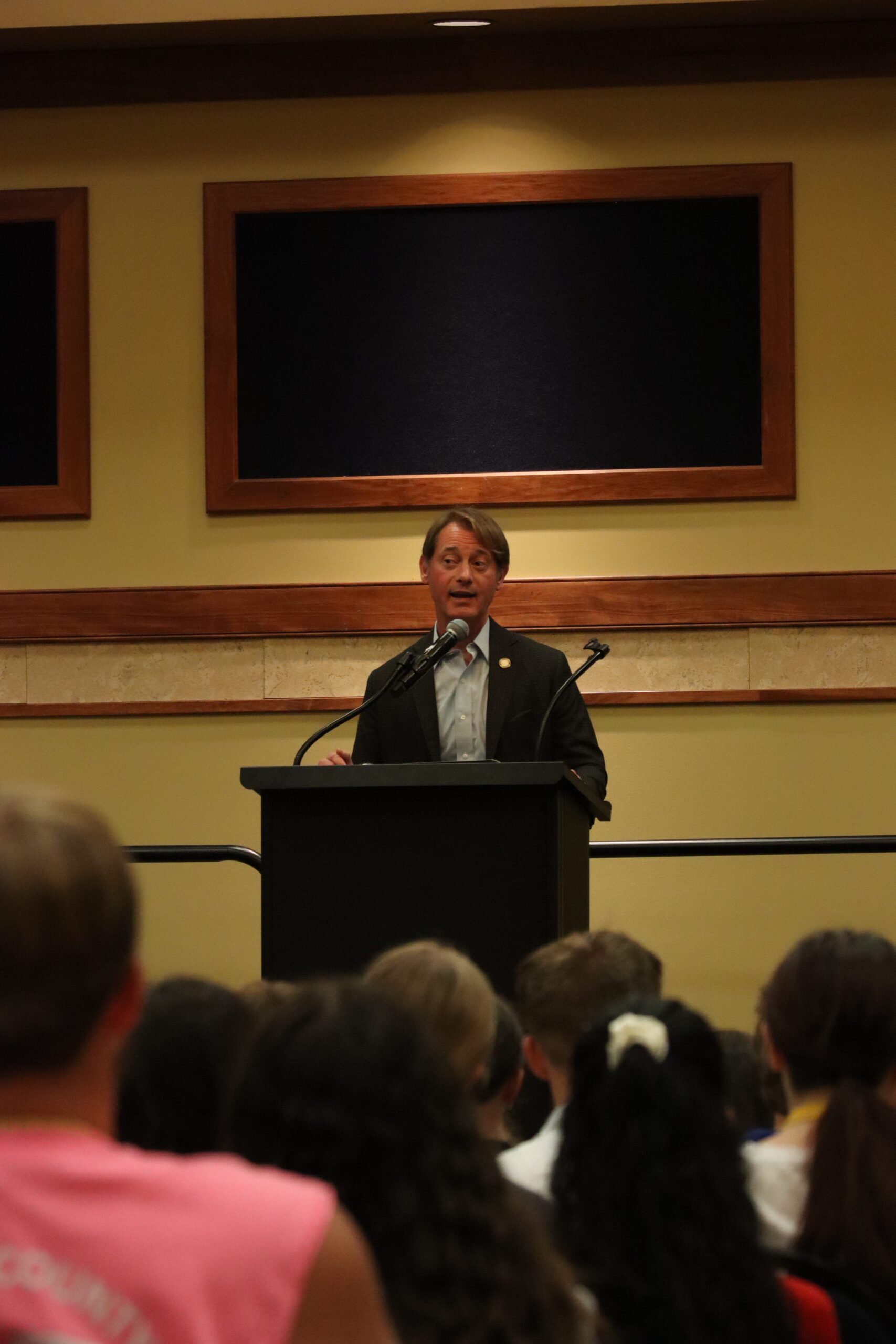
On Wednesday, July 8, 2026, Scholars attended their third convocation, hosted by KY Secretary of State, Michael Adams. Michael Adams is a NKU 93’ GSP Alumni and Kentucky’s 86th Secretary of State. He graduated from McCracken County Public Schools, became a first generation college student, and attended Harvard University on low-income aid. He worked for Senator Mitch McConnell and Governor Ernie Fletcher before moving to Washington to serve as Counsel to the U.S. Deputy Attorney General in the Bush administration. In 2007, Adams began private practice in election law, building a national practice in the field. He’s represented national political committees, political figures, and statewide campaign efforts in all 50 states. In 2016, he was appointed to the Kentucky Board of Elections and inaugurated as Secretary of State in 2020. In 2021, Adams presented the most ambitious election reform plan since the late 1800s, passing with near unanimous support. He was reelected to the office of Kentucky Secretary of State in 2023.
Adams spoke on the importance of political involvement and need for empathy in the midst of an ever-growing digital society. He began his speech by describing the changes in the political landscape of the United States since the 1990s. In 1991, Adams said, CNN was only 10 years old, and Fox News was not yet in existence. There was news, and there was entertainment, but the two were never combined. There was no remote work, there was no remote voting, and people were forced to communicate face-to-face. With the rise of the internet, the line between news and entertainment became blurred. Anyone was able to post and share their opinions to the world.
“The internet also made it hard for us to sort out who was right or even who was credible,” Adams said. The internet provided a platform for anyone in the world to share their perspectives and information, regardless of whether or not those were true. Suddenly, anyone with a conspiracy theory could simply start their own website or blog and mass-share those opinions to others, without having to prove whether or not they were telling the truth.
In a more modern light, this has led to the rise of influencers who push people to vote for certain parties, but do not always have accurate information or knowledge. Adams discouraged scholars from following these trends, and encouraged them to instead focus on individual research and development of perspectives. Adams informed scholars about the need for individualized thinking, as well as the importance of “thinking local” by volunteering to work the polls and joining local organizations.
“What’s going on in your city, county, even your state doesn’t trend, so it doesn’t get covered,” Adams said. This has essentially flipped the United States’ system on its head, because now, more people are directly watching the federal government without any idea of what is happening in their communities, despite the fact that community leaders are far more accessible than someone like the president of the United States.
“It’s no wonder that in politics, character and integrity matter less,” Adams said. He instructed scholars to reach out to their local officials, and get to know the leaders in their communities.
“Today’s communication technology has made the world much smaller,” Adams said. According to Adams, the average person spends less than 34 minutes a day socializing with people or at social gatherings. He emphasized that people need to spend more time with each other, especially those with differences, in order to bridge political and social divides. He concluded his speech by reiterating the importance of making those real-world connections, and getting out into the community to meet people.
Following that, Adams opened up the floor for question and answer.
For 40 minutes, scholars inquired about things such as Adams’ career, political action committees, gerrymandering, development of empathy, data centers, national and local issues, and politics in social media.
Scholars were encouraged to be politically active and contribute to a new generation of civic leaders in local communities.
By Abigail Coty and Almir Memic